
How many cups in a quart? There are 4 cups in 1 US quart, which is the same as 2 pints or 32 fluid ounces. If you cook often, you’ve probably hit that moment where you’re staring at a measuring cup trying to remember the answer halfway through a new recipe. I’ve been there, trust me.
What You’ll Learn
- Get the quick answer for how many cups are in a quart, plus pints, ounces and tablespoons.
- Use my quarts to cups and cups to quarts charts for any amount from ¼ quart to 2 gallons.
- Learn the easy Big G trick, plus the difference between a liquid quart and a dry quart.
- Free printable: Download my free cups in a quart chart (PDF) to keep on your fridge.
These conversions follow the United States customary system, which is the unit of volume most American recipes use. Below you’ll find two easy conversion charts, ounces, dry quarts, and the simple trick I use to remember it all. That way, you can get right back to cooking.
How Many Cups in a Quart?
Also, recipes and cartons often shorten quart to qt. In other words, a quart is a quarter of a gallon, which is where the name comes from. Here’s how one US liquid quart breaks down:
- Cups: 4
- Pints: 2 pints
- Fluid ounces: 32 fluid ounces
- Tablespoons: 64 tablespoons
- Gallons: ¼ gallon
- Milliliters: about 946 milliliters
To convert, multiply the number of quarts by 4. Then, to go the other way, just divide by 4. In short, that one conversion factor is all you need.
Quart to Cups Conversion Chart
Recipes don’t always call for an even quart, so this chart covers the amounts that show up most in soups, casseroles and big batches of drinks.
| Quarts | Cups |
|---|---|
| ¼ | 1 |
| ½ | 2 |
| ¾ | 3 |
| 1 | 4 |
| 1½ | 6 |
| 2 | 8 |
| 2½ | 10 |
| 3 | 12 |
| 4 (1 gallon) | 16 |
| 5 | 20 |
| 6 | 24 |
| 8 (2 gallons) | 32 |
How Many Cups Are in Half a Quart?
Half a quart is 2 cups, which is also 1 pint.
How Many Cups in 2 Quarts?
Similarly, there are 8 cups in 2 quarts. That’s half a gallon, the same size as a half-gallon carton of milk.
How Many Cups in 4 Quarts?
Likewise, 4 quarts equal 16 cups, which is exactly 1 gallon.
Cups to Quart Conversion Chart
Going the other direction? Just divide your cups by 4. For example, a half cup is ⅛ of a quart.
| Cups | Quarts |
|---|---|
| 1 | ¼ |
| 2 | ½ |
| 3 | ¾ |
| 4 | 1 |
| 6 | 1½ |
| 8 | 2 |
| 12 | 3 |
| 16 | 4 (1 gallon) |
Pints, Quarts and Gallons
Once you know the quart, the rest of these US measurement units fall right into place.
How Many Cups in a Pint?
A pint holds 2 cups.
How Many Pints in a Quart?
Every quart holds 2 pints.
How Many Quarts in a Gallon?
Altogether, a gallon holds 4 quarts.
How Many Cups Are in a Gallon?
So there are 16 cups in a gallon. If you need fluid ounces instead, my How Many Ounces in a Gallon? guide has a full chart.
An Easy Way to Remember How Many Cups Are in a Quart
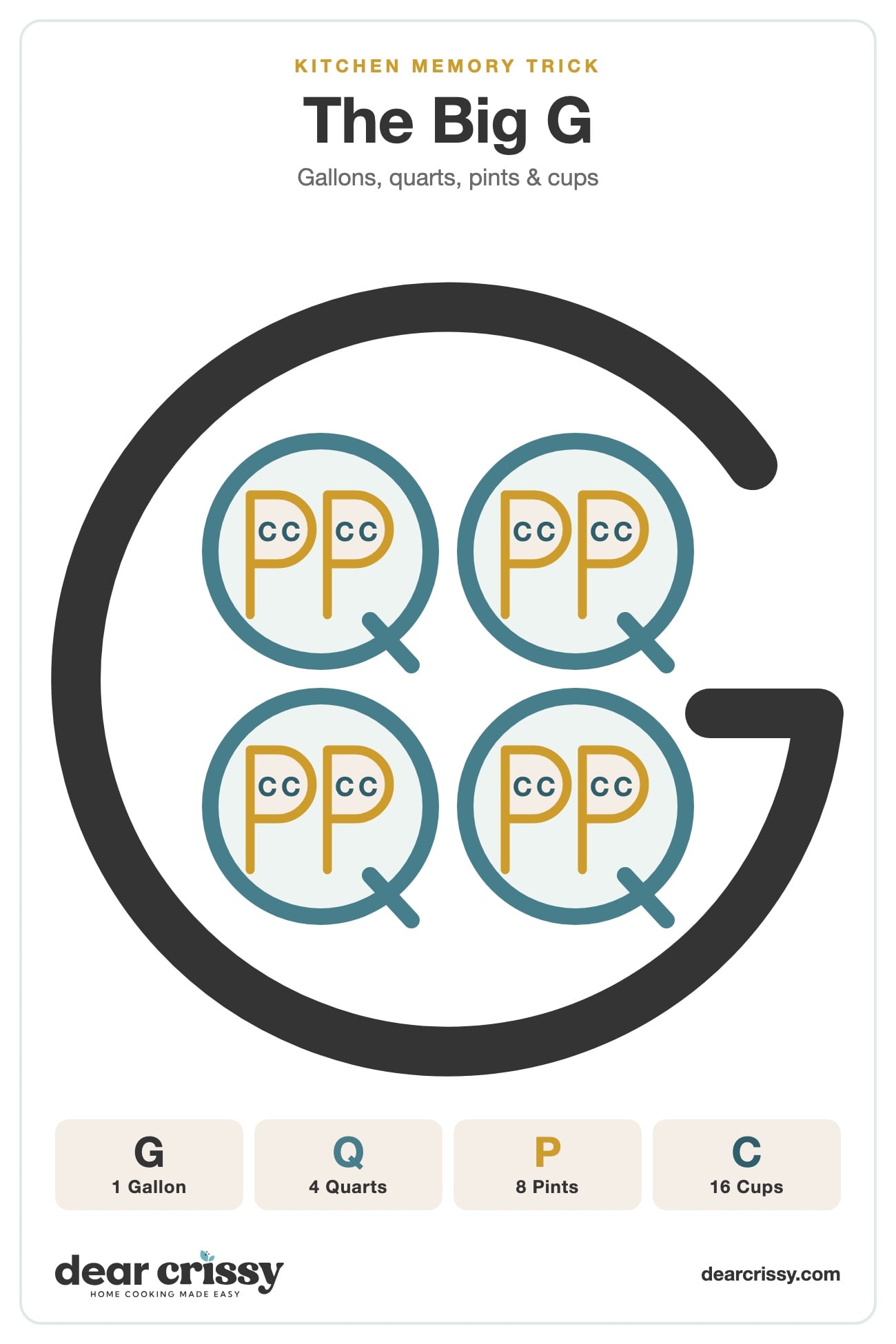
If you want an easy reference that sticks, picture a big G for gallon. Inside it, imagine four Qs for quarts. Then, inside each Q, picture two Ps for pints. Inside each P, picture two Cs for cups. Because everything nests inside the next thing, the whole chart becomes a simple pattern you can remember without much effort.
So when you’re stuck, count the Cs inside one Q. You’ll find 4 cups in every quart. Be sure to save the Big G chart above to Pinterest so you don’t forget.
Liquid Quart vs. Dry Quart
First of all, a dry quart isn’t the same as a liquid quart. A US dry quart is about 16% larger and holds roughly 4.65 US cups. In fact, you’ll mostly see it for produce sold by volume, like a quart of strawberries or cherry tomatoes at the farmers market.
On the other hand, when a recipe calls for a quart of milk, a quart of water or a quart of broth, it means the liquid quart. For everyday cooking with liquid ingredients, that’s the one you’ll use almost every time.
US Quarts vs. Imperial and Metric Measurements
If you’re using a recipe from the United Kingdom, Australia or New Zealand, the numbers change a little. Here’s what to watch for, especially with older recipes:
- Imperial quart: The UK quart is about 1.14 liters, or a little more than 4¾ US cups. An imperial cup is also larger than a standard US cup.
- Metric cup: A metric cup is 250 milliliters, so one US quart equals about 3¾ of them.
- Liter: A liter is slightly bigger than a quart. It equals about 1.06 quarts.
Because of these different systems, it’s smart to check where a recipe came from before you start measuring. Otherwise, you can end up with a very different final product.
Tips for Measuring Accurately
- Use the right cup: Liquid measuring cups have a spout and lines on the side, while dry measuring cups are made to be filled to the top and leveled.
- Read at eye level: Set your liquid measuring cup on a flat surface and bend down to check the line, rather than looking down from above.
- Level dry ingredients: First, spoon flour into the cup, then sweep the top with a butter knife. Brown sugar is the exception, so pack it in firmly.
- Go big for liquids: A large glass measure that holds a full quart lets you pour broth or water in one go.
- Weigh it for baking: Kitchen scales give the most consistent results, since a cup of flour can weigh different amounts depending on how you scoop it.
- Leave room when freezing: Liquids expand as they freeze, so don’t fill a quart-sized container all the way to the top.
Where You’ll Use Quarts in the Kitchen
- Broth: For instance, a 32-ounce carton of chicken broth is 1 quart, or 4 cups. That comes in handy for soups like my Crock Pot Chicken Noodle Soup.
- Slow cookers: Crock Pots are also sized in quarts. For example, a 6-quart Crock Pot holds about 24 cups when full to the brim. Since a slow cooker works best filled half to two-thirds full, that’s about 12 to 16 cups of food.
- Mason jars: A quart mason jar is perfect for leftover soup or homemade stock.
- Milk and juice: Likewise, a half gallon of milk is 2 quarts, and a gallon is 4.
Free Printable Cups in a Quart Chart
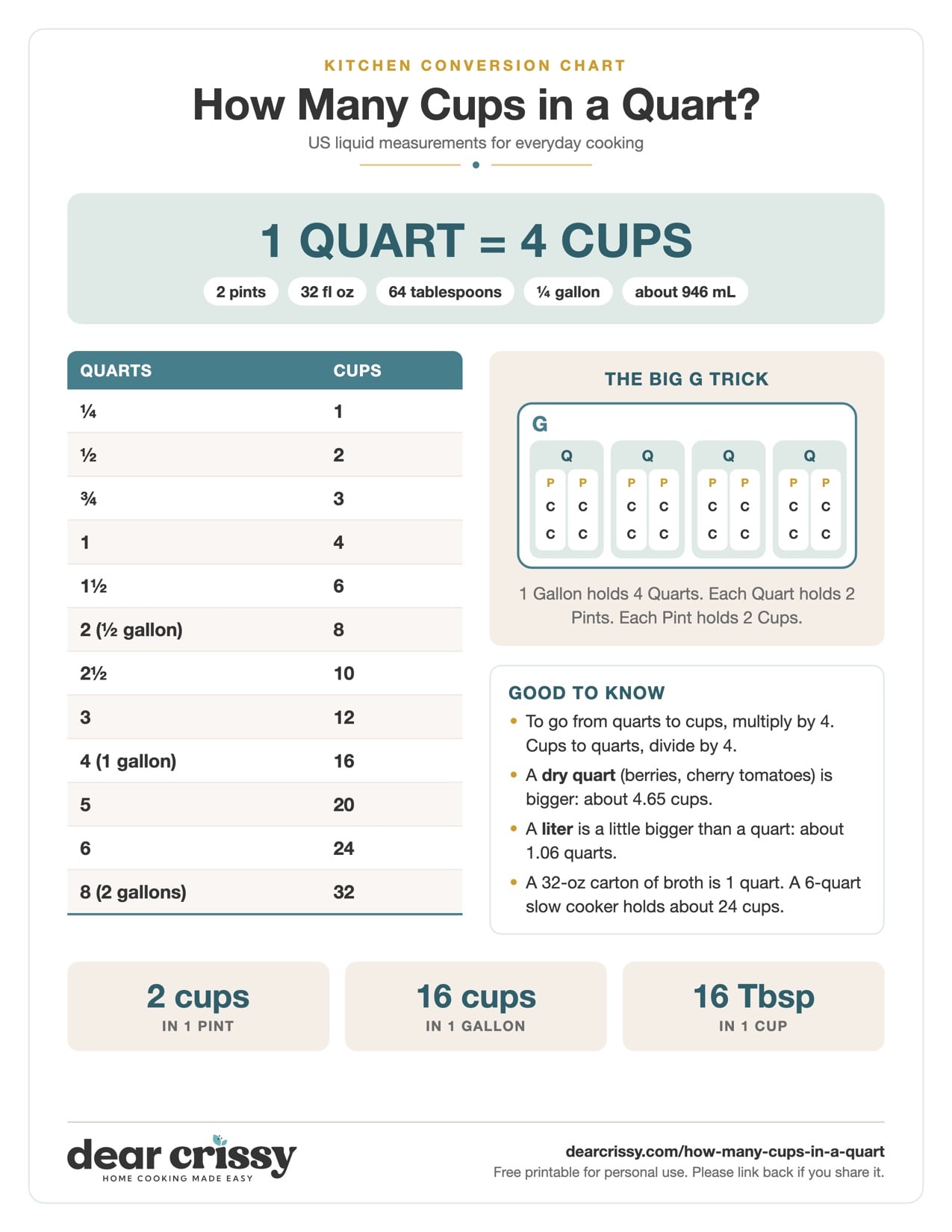
I put everything on this page into one handy chart. Print it out and stick it on your fridge, or keep it next to your measuring cups.
Share this chart on your site
You’re welcome to share this chart on your blog or website. Copy the code below and paste it into your page’s HTML so it links back here.
Frequently Asked Questions
In US liquid measurements, yes. A dry quart and a UK imperial quart are both a little larger, so check which one your recipe means.
It’s 4, the same as milk, broth or any other liquid, because a quart measures volume, not weight.
Group your cups into sets of four. Each set equals one quart. It’s the easiest way to keep track without doing math.
Yes, a US quart is 32 fluid ounces. Keep in mind that fluid ounces measure volume, while ounces on a kitchen scale measure weight.
No, a liter is slightly bigger. In fact, one liter equals about 1.06 quarts.
There are 64 tablespoons in a quart, since each cup holds 16 tablespoons.
In the end, you don’t have to remember every little measurement on your own. Instead, keeping a simple chart nearby takes the pressure off so you can focus on the part you actually enjoy, which is cooking something good for the people you love.
So bookmark this guide or pin the Big G chart, and it’ll be right there the next time a recipe calls for a quart.


I need 7 quarts of popped popcorn. How do I do that?
My Apple Butter is easy. Need a lg crockpot. Peel,core & slice enough apples I use Granny & Fuji) to fill crock. Add 2 C Sugar, 2 Tps Cinnamon, 1 tsp All Spice, 1/4 tsp nutmeg. Stir til mixed. Cool on high 4-5 hrs or low 8-10. Ladle apples into a blender. Blend until smooth. Pour into hot jars & seal!
I like your table. It’s really good and really helpful, but you forgot to include all the other measurements (including teaspoons, tablespoons, ounces, pounds, & liters), as well as which are liquid measurements, and which are dry. One of the other things that drives me insane now is, are we talking about U.S. units, or imperial units, now that we can get a lot of our recipes (as well as our products) overseas.
What is the equivalent in kgm for 1 quart of Jerusalem artichokes?
I always have to double check measurements. I won’t be printing the chart but it’s a great visual.
This chart would be very helpful to me! I am constantly looking up measurement equivalents, especially for baking.
Yes, I’m going to print and use this chart. I can never remember the conversion.